Total Pageviews

Showing posts with label techniques. Show all posts

Saturday, 9 August 2014

DOES A WORKOUT GIVE YOU A BAD HAIR DAY?

 
Apparently it does. and it's worse for women of African origin.
 
A study conducted by the Center for African American Health and the University of Colorado School of Medicine's Center for Women's Health Research finds that African American women whose hairstyle is affected by perspiration may avoid physical activity altogether. Prior studies have found that between 29 percent and 48 percent of African American women say that their hairstyle was a factor in deciding whether or not to exercise. Some women involved in the study who experience hairstyle barriers to physical activity explained that it can take too much time or money to restyle their hair after exercise that causes perspiration.
 
Hair issues may be reduced by using "low-maintenance" hairstyles such as wearing braids or ponytails. Researchers are looking for ways to reduce the effects of pespiration on the hair.


Saturday, 5 July 2014

OCCLUSION TRAINING

 Some of the top trainers in bodybuilding are currently employing occlusion training or blood flow restriction training, as it is also called. It's a technique in which the upper arm or upper leg is wrapped with a compression sleeve, knee wrap, or wrist wrap, to the point where the veins are mildly compressed, but not so tightly that the arteries are restricted.
Occlusion Training: Get Bigger Lifting Lighter
 
According to Dr. Layne Newton, Blood Flow Restriction training when performed properly allows one to use much lower weights than normal training protocols and still achieve sizable anabolic training responses. If you can find the perfect line between "tight" and "too tight," you create a state in the muscle where the blood can get into the muscle through the arteries, but has trouble exiting the muscle through the veins. Metabolic by-product accumulation is primary mechanism by which occlusion training produces hypertrophy. These metabolic by-products would normally be ‘washed out’ by normal blood flow, but occlusion allows them to accumulate near the muscle.  In other words, occlusion training drives more total blood into the muscle. Dr. Jacob Wilson cited three major reasons why this is beneficial.
 
Occlusion training engorges muscle cells with so much fluid that the muscle cells are forced to stretch and expand. You may think you've experienced "skin-tearing" muscle pumps during blood-gorging sets, but this technique could make you rethink what a pump can be.
 
The accumulation of blood in the muscle lowers the cellular oxygen levels and makes your muscles feel weaker. In response, your body recruits the larger fast-twitch muscle fibers, which are more receptive to growth.
 
Finally, when oxygen is low, lactic acid rapidly accumulates in the muscle. This may sound bad—and I'll be honest, it doesn't feel great—but some recent studies have shown that lactic acid by itself can increase protein synthesis and spur muscle growth.
 
BFR training is very difficult even though the loads are very light. It is easily the most painful form of training I have ever performed. As always, before starting any kind of new training protocol, you should talk with a medical professional. BFR can be performed for the thighs, calves, upper arms, and forearms using a blood pressure cuff or tightly wrapped knee wraps (more practical). To occlude the thighs and upper arms, wrap at approximately 70% of maximum tightness around the uppermost part of the muscles. To occlude the calves or forearms wrap at approximately 70% of maximum tightness just below the knee or elbow.
 
Perform 3-5 sets to muscular failure with 20-50% of your 1 rep max on a given exercise with the muscle occluded the entire time. Rest periods should be 30-60 seconds between sets. After the final set remove the wraps and restore blood flow to the muscle. A word of advice, be prepared for a lot of pain and if you do not find yourself in excruciating pain, the odds are the wraps are not tight enough. Try blood flow restriction training and take your training to another hypertrophic dimension


Friday, 4 July 2014

3 TECHNIQUES TO TURBO CHARGE YOUR MUSCLE GAINS

I believe in squeezing out the maximum benefit from each workout session. Here are my 3 favorite training techniques to get the most from each and every exercise, in no particular order. These strategies will make your existing training routine more effective and diverse when it needs a boost.
 
Pre-exhaust training
 
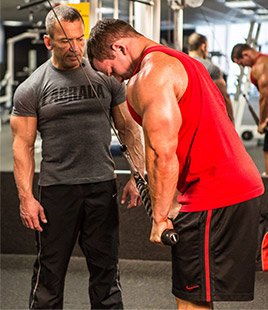
Pre-exhaust training utilizes isolation movements to tire out a specific muscle group before moving on to a compound movement. For example, you could perform a chest fly before the bench press, or leg extensions before you squat. I usually carry out 100 tricep pushdowns and cable curls to warm up my arms and hit the muscles deeply.
 
 
The pre-exhaust method is one of my favorite training techniques for several reasons. First, by significantly fatiguing the isolated muscle group, it forces the fresh muscles to pick up the slack during the compound movement. The fatigued muscle gets pushed beyond what it would have been able to do without the pre-exhaust sets, and you don't have to sacrifice the full-body strength stimulus of, say, a bench press by trying to make it into a chest isolation exercise.
 
Supersets
 
A superset is two exercises performed back to back with no rest between the exercises. Supersets can increase your workout density, shorten your workout duration, spur new growth, and deliver an incredible pump. You can pair exercises for the same muscle group, like a triceps push-down and close-grip bench press, or pair movements for opposing muscle groups, like biceps curls and triceps push-downs.
 
I love to use this technique in conjunction with the pre-exhaust technique. As shown by the triceps push-down and close-grip bench press example above, I like to perform an isolation exercise to pre-exhaust a muscle and then immediately follow it with a compound move. This drives the target muscle past the point of failure and results in a killer pump.
 
Rest- Pause Training
 
Rest-pause training incorporates a brief rest period, or even a couple of rest periods, during a single set. This allows you to move a heavier weight for more reps than you could in a straight set. You allow your muscles to partially recover, but not completely, before you hammer them with another barrage of heavy reps.
For example, if you were to perform rest-pause on a set of triceps push-downs, you would first perform reps until you reach failure or a predetermined number of reps, and then you would rack or hold the weight, take an extremely brief rest period of 5-15 seconds, and rep to failure again. The brief rest allows you to extend your set and overload the working muscle.
Rest-pause sounds simple, and it is, but I would warn you to pay close attention to your form. Don't use such a heavy weight that you have to get sloppy to move it. While some people go crazy with rest-pauses and use them in multiple sets on a regular basis, I advise you limit them to a single set of each exercise you perform. Rest-pause is an overload technique, not a replacement for straight sets.
 
Incorporating these techniques into your training program will supercharge your muscle gains, building ip more muscle whilst giving you razor sharp definition.
 

Thursday, 3 July 2014

TYRE FLIPPING: PROS AND CONS

You 'Mirin?
 
 
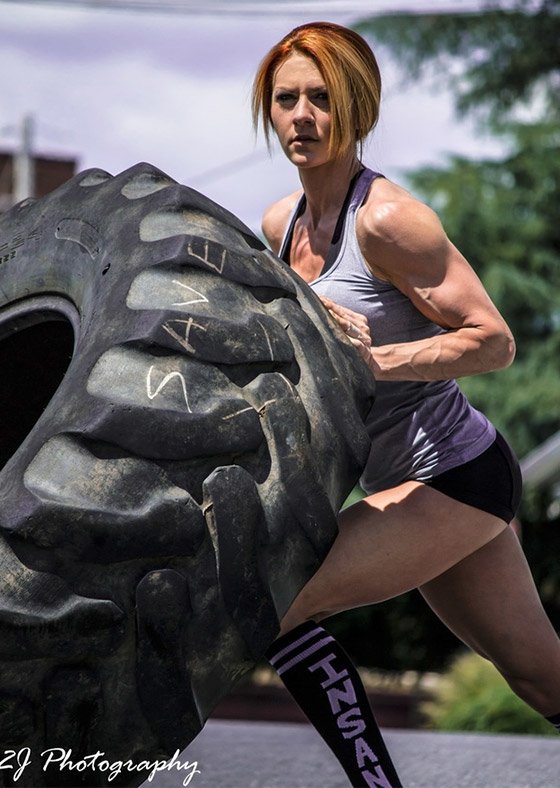
There's no doubt about it: Tire flips are one of the coolest-looking exercises you can possibly do. Tire training is one of the best total body strength and conditioning workouts that a person can do. You use your total body when you flip the tire, and by varying the distance you flip the tire and time you flip the tire you can get a great aerobic workout. However, it is also one of the most dangerous moves you can concieve of if not performed properly.
 
 
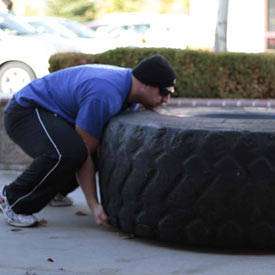
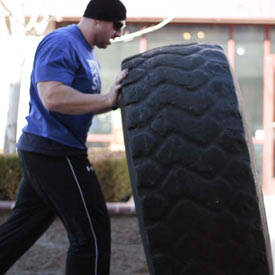
When you flip the tire it is best to start with the tire flat on the ground. Place your fingers and hands as far under the tire as you can in this position and keep your hands about shoulder width apart. Squat down and then while pulling the tire up with your arms and back explode out of the bottom position. As the tire comes up you should have enough momentum that you can change your hands from a pulling to a pushing position and push the tire all the way over. Immediately after the tire is pushed over and flat start the process again.
Florida-based personal trainer Rob Simonelli agrees. "Tire flips are best used for folks who'll have to flip tires in some sort of strength competition," he said. Furthermore, hardly anyone has the hip mobility to do it right. Just about everyone, including Strongman competitors, goes into lumbar kyphosis -- a rounded lower back -- when they bend down to grip the tire.
World-famous, Boston-based strength coach Mike Boyle said, "Most people don't have bad backs. They've got bad hip mobility, which causes their bad back."
When it's used as a training exercise, the goal is to work the posterior-chain muscles, like the lower back and the hamstrings. That's something you can accomplish very well with deadlifts. According to some authors ,the only real benefit to doing tire flips is the fact they're often done outside, where other people can see you doing these stunningly badass exercises. But "because it's badass" isn't necessarily a good reason to do it.


Tuesday, 1 July 2014

THE HOTTEST FITNESS TRENDS ROCKING THE WORLD


When it comes to fitness trends, they're constantly evolving. Millenials are leaning toward new forms of fitness, such as obstacle races and marathons.  From Zumba to CrossFit it seems like new forms of exercises are being brought to our attention daily. This new wave of personal fitness aligns with key millennial values  i.e the communal mindset and an active lifestyle. Millennials are an on-the-go generation and are loyal to brands that can keep up with them and adapt to their multitasking way of life. In order to be healthy and active you must find an activity you enjoy partaking in.
 
So, if you still haven't found that fitness niche, don't worry. Step outside your comfort zone and try something new. With trends in the industry popping up so frequently, you're bound to find one that you enjoy sweating to. Smartphone fitness apps have taken over the market and are connecting millennials through a new form of communication that has never before been used in the fitness industry.
 
1. Social Fitness
How
 
For those ages 12-30, playing sports is as much about socialization as it is about perspiration. The Sporting Goods Manufacturers Association’s annual report found that millennials are more likely to partake in physical activity that is more focused on togetherness instead of competition. In 2011, millennial participation in cycling and aerobics (usually done in groups) rose by 30 percent and 20 percent respectively. For millennials, group fitness creates an environment where everyone helps to push each other to be their best instead of competing for a victory.
 
2. Computerised Fitness
 
People are using their personal technologies to track their health often on a daily and even minute-by-minute basis. By monitoring the activity of friends, family and other individuals, you can emulate their healthy habits, workouts, style, and favorite foods. Following a registered dietitian or fitness expert on Instagram, for example, can be a treasure trove of valuable information on healthy foods to eat and exercises to try. Not everything fitness-related on social media is rainbows and unicorns. Some posts on social media can be downright toxic. Plus, watching your favorite athlete make regular progress can motivate you.


Tuesday, 24 June 2014

BEDROOM HEAT: MASSAGE YOUR WAY TO PARADISE

Sometimes, you don't need much more than your two hands to get your stressed partner into a very pliant mood. Nothing says romance like a deeeply relaxing sensual massage. Add some relaxing music, softly scented oil and aromatherapy candles and you'll turn your partner into putty in your hands, almost literally. And if you want to to take things to the next level, pour out some red wine and keep some bedroom food handy(strawberries, red grapes, soft white chocolate, whipped cream). Understand that the process must be erotic, but no sex must occur till its completion; the anticipation of sexual release heightens the pleasure of the experience.
 

how to give a sensual massage

 
Start out the massage by gently warming the massage oil (this could be Almond, jojoba, Moringa, Argan, Avocado, Coconut oil or any other oils that you feel comfortable with) between your palms, and ask your partner to lie face down on the bed. Most people have some major erogenous zones on their backs, especially around the shoulder blades, lower back, the back of the knees, and obviously- the gluteal muscles (i.e the butt).  Lay your finger tips on the body part and gently rotate your hands, applying some pressure in order to loosen up the muscles and remove any knots. Avoid pressing too hard so as not to cause pain to your partner.
 
 
After the Shiatsu, progress to long, gentle stroking movements (effleurage), keeping your fingers together, thumbs parallel and palms in full contact with the body part you are working on. Stroke from the lower back to the shoulders. Follow this up by compressing movements, where you gently apply pressure to the body part in order to warm up the muscle and keep the blood flowing.
 
By now, your partner should be emitting signs of intense pleasure; this is the time when you up the ante. Knead the more fleshy parts of the body such as the buttocks; create a roll of skin using your thumbs and gently push it up, like a baker kneads bread. Gently stroke the inner thighs and legs, avoiding the genitals (despite the temptation to do so). The feet  and hands provide a sensual map of the body; use some gentle shiatsu, working your thumbs from the heel to the toe and finger tips.
 
The next stage should be chest massage, start by carressing from the upper chest to the shoulder and stroking from the lower chest to the upper pelvic area. This chould have your partner bucking in anticipation- but the fun is yet to begin. For the guys, take your time and be gentle with your woman; focus on the underside of the breasts, kneading them gently until she begs you for release.
 
Before you progress to any sexual touching, make sure your partner begs, sensual massage is the ultimate form of power play and you should revel in it. enjoy!


Tuesday, 10 June 2014

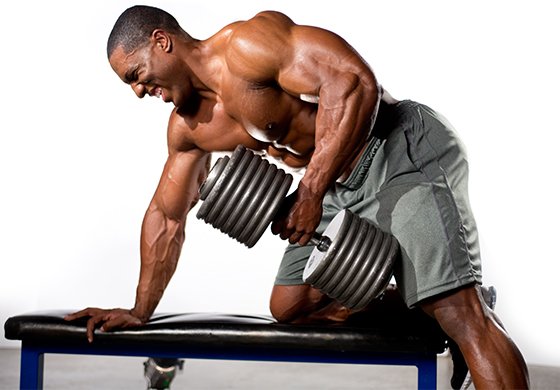
IS TRAINING TILL MUSCLE FAILURE NECESSARY

Failure occurs during the lifting phase of a repetition when the muscles can't produce sufficient force to continue to move the weight upward. But critics and supporters of training to failure often phrase their argument in non-anatomical terms, as if your stance on failure goes to the very heart of who you are as an athlete, or even a person.
 
 
Failure comes in two ways: muscular and mechanical. Muscular failure is when you absolutely cannot lift the weight anymore and is employed in low volume/high intensity programs (typically.) Mechanical failure is when you start to slow down and/or lose form and is used in high volume programs, especially if you train alone and do not want to risk injury.
 
It has been established that training to failure increases lactic acid production more than non-failure training, and greater increases in lactic acid in muscle are critical for muscle growth, because they trigger increases in intramuscular growth factors.

A second benefit to training to failure is that, near the end of a set, all of your smaller muscle fibers become fatigued. Faced with the continued challenge of lifting a heavy weight, your nervous system is forced to use your body's larger fast-twitch muscle fibers.
 
The only problem with this approach is that once you have taxed the nervous system on a set to failure, you develop "central fatigue." Once your nervous system is fatigued, all following sets will be performed at a much lower capacity. You're setting yourself up for injury if you go to failure too often, especially with high volume/heavy weight. It's why you never see people who are natural (important part of this statement) who are elites that go to failure because it's dangerous and will lead to injury eventually (because if you do high reps, heavy weight and heavy volume, you'll burn yourself out and injure yourself because of form breakdown).
 
While failure may be a powerful tool in a bodybuilder's training regimen, it comes with a significant cost. The take-home message is that athletes need to be aware that this tool is taxing, and it shouldn't be treated lightly. If you're going train to failure, do so strategically and appropriately in a training program.
 
Failure occurs unassisted, but there are ways, such as forced reps and dropsets, to push past even that threshold. To perform a forced rep, a trainee reaches failure and then receives assistance from a training partner to continue the set. Dropsets, on the other hand, don't necessarily require a training partner. You just continue an exercise with a lower weight after hitting failure at a higher one. In either case, your body feels these techniques even more intensely than failure, for both better and worse.

The benefits of forced reps and drop sets are similar to failure training: greater metabolic stress, more lactic acid, and more muscle fiber recruitment. However, both techniques cause far greater central fatigue than normal failure training