Total Pageviews

Showing posts with label fitness training workout weight loss. Show all posts

Saturday, 27 September 2014

BENEFITS OF GREEN TEA

I just had a cup of green tea and honey, and I felt so inspired that I just had to write about it.

 
Green Tea iced tea
 
Tea drinking has been an active part of many Asian cultures for centuries, and whilst it was reputed to possess health benefits, the health benefits of Green tea are yet to be fully uncovered. Studies have found an association between consuming green tea and a reduced risk for several cancers, including, skin, breast, lung, colon, esophageal, and bladder. This is because Green tea is the best food source of a group called catechins. In test tubes, catechins are more powerful than vitamins C and E in halting oxidative damage to cells and appear to have other disease-fighting properties.

 
 
keep-calm-and-drink-green-tea-39Drinking a cup of tea a few times a day absorbs antioxidants and other healthful plant compounds, boosting your metabolism and promoting weight management. In green-tea drinking cultures, the usual amount is three cups per day. Allow tea to steep for three to five minutes to bring out its catechins.
 
The best way to get the catechins and other flavonoids in tea is to drink it freshly brewed. Decaffeinated, bottled ready-to-drink tea preparations, and instant teas have less of these compounds. Tea can impede the absorption of iron from fruits and vegetables. Adding lemon or milk or drinking tea between meals will counteract this problem.


Monday, 22 September 2014

WHAT FORM OF CARDIO IS BEST FOR ME?


The cardio machines in your gym or fitness centre can be a persistent source of confusion if you don't understand the different benefits provided by each cardio machine. When it comes to getting results, boosting your fitness and shrinking your waistline, the best cardio machine is the one that burns the most calories. In the course of researching the different benefits derivable from cardio machine training, I came across a Huffington Post article by Bob Greenfield which encapsulated my views on various machines.
 
The Bike

Product DetailsThe pedaling motion of the bike incorporates the big and powerful leg muscles and can burn 500-1,000 calories per hour, which ranks it among the highest calorie burners (as long as you use it correctly). But most people don't choose a resistance that is high enough to stimulate all the calorie-burning leg muscles, and instead let the natural movement of a bicycle's pedals do the work for them. To get maximum benefit from a bike, choose a resistance that makes you breathe hard at 90 RPM (revolutions per minute). Most stationary bicycles show RPM on the computer display.
 
The Treadmill
Product Details
Running on a treadmill can burn 600-1,200 calories per hour, and running up an incline on the treadmill is the best way to boost your metabolism for hours after you've finished your workout. In contrast, walking on the treadmill burns only 150-400 calories per hour, depending on your speed and incline. If you're using a treadmill, then either run or jog (if your joints can handle it) or walk up a steep incline. Avoid the common mistake of constantly holding on to the handrails. These should only be used if you have extreme balance difficulties or must stabilize yourself to change a setting.
 
The Elliptical
Product Details
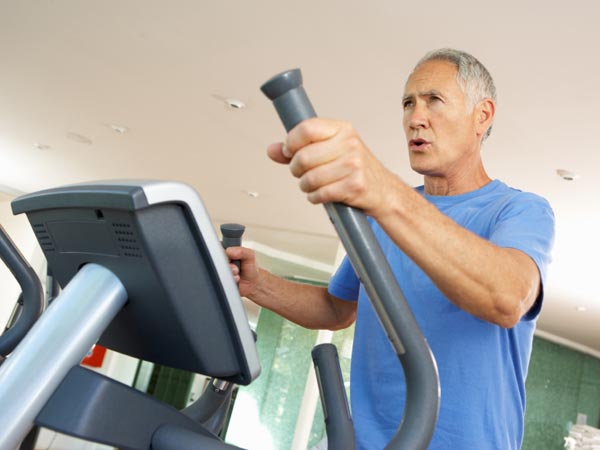
You generally burn about 600 calories per hour on the ellipticals that don't include arm movement, and 700-900 calories on the ones that do. Using an elliptical burns fewer calories than running because once you get the parts on an elliptical moving, they use momentum to keep going, and you expend less energy. To get the best results on an elliptical, use the rails as little as possible, and challenge yourself with the resistance settings. You should be breathing hard while aiming for a cadence or stride rate of 120-140+ (this is shown on the display). If you don't feel your muscles contracting during the forward and back stroke of the elliptical, then you probably need to increase resistance.
 
The Stairmaster
Product DetailsProduct Details
Although the stairmaster is popular, it doesn't get great results. It incorporates small, low-calorie burning calf muscles, and just a small part of your upper thighs and butt -- and only burns at most 400-500 calories per hour. In addition, if you have low back pain, then you may find that the pain is aggravated during the up and down motion of the Stairmaster.
 
However, if you are lucky enough to have access to the kind of machine where you walk up a moving belt of stairs (like a stationary staircase), then you can get far better results. It will give you just as much calorie-burning benefit as running up an incline on a treadmill, and do a fantastic job toning your butt and thighs. While using it, try holding dumbbells or switching to a slow pace and taking 3-4 steps at a time.
 
The Rowing machine
Product DetailsProduct Details
The rowing machine can burn over 1,000 calories per hour, and it's an excellent upper and lower body muscular endurance and cardiovascular workout. But it can be boring. To make things more interesting on the rowing machine, try to intersperse short periods of very hard pulling with easy pulling. For instance: row for 250 meters as hard as possible, then row 100 meters easy, and repeat 6-8 times. When rowing, use both your torso and legs -- not just your arms.
 
No matter which form of cardio you choose, be sure to regularly switch things up and incorporate new forms of cardio that are unfamiliar to your body. So if you always walk, then switch to cycling or the elliptical; or if you always run, then try rowing. This will ensure that your body is constantly challenged and burning as many calories as possible.

Sunday, 21 September 2014

CELEBRATING YOU

"the only person you should be comparing yourself to is who you were yesterday"
 
 
Many people begin the fitness journey by hating themselves, and this leads to unhealthy or downright dangerous health and fitness habits. Walk into a gym and you're likely to see people  going through the motions of training in ways that are detrimental to their health, all for the purpose of looking like someone else.
 
The fitness journey isn't only about being thinner, bigger, stronger or fitter; it's about discovering who you really are inside. When you get into the gym, discard any preconceptions you hold about your appearance (indeed, the mind often makes us look far worse than we really look). Focus on the workout at hand, crank out as many sets as possible, and Go home happy and fulfilled.
 
Remember, it's a lifelong marathon, not a sprint.


Saturday, 20 September 2014

TEN TOP FAT LOSS ERRORS


Best And Healthy Way To Weight LossThe A stands for "all the other people" you're over serving in your life. Take care of yourself, first!

1. You focus too much on exercise and forget nutrition. The workout is not nearly as important as proper nutrition.
 
2. You don't eat enough.

3. You think you can outtrain a bad diet.

4. You think that the more you exercise, the better.

5. You actually believe you can lose 14 kg in 4 weeks

6. You believe fat converts into muscle, and you fail to plan to build muscle.
 
7. You spend hours on the cardio machine.

8. You forget that fitness is more than losing fat.

9. You fail to congratulate yourself for the small successes

10. You don't read LegallyMuscled

Tuesday, 16 September 2014

THE BENEFITS OF YOGA TRAINING

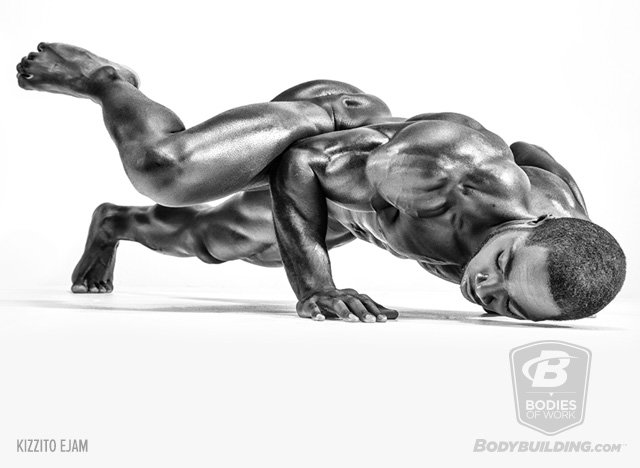
Kizzito Ejam
 
A few months ago I encountered a 60-something year old Indian psychotherapist on a flight from Mumbai. This elderly man was impressively vibrant and flexible for his age. In fact, he was capable of performing a full split and he displayed this ability, attributing his extraordinary flexibility to a strict regime of Yoga training.
 
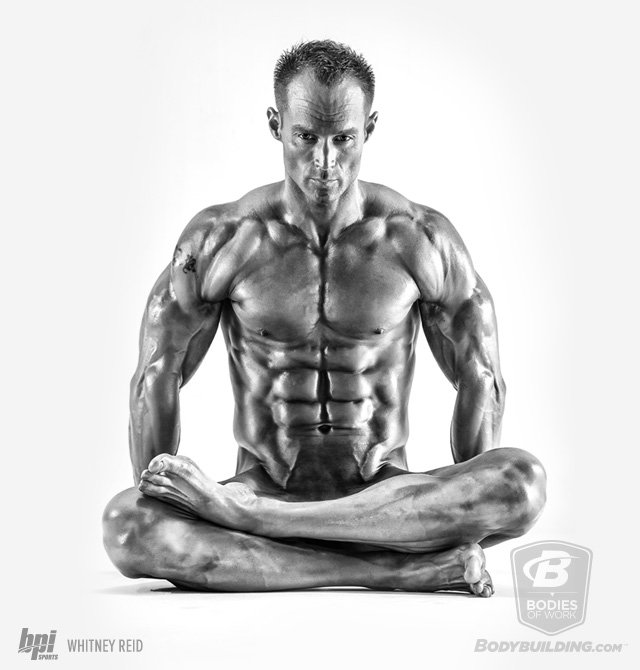
Whitney Reid
 
Yoga teaches us how to adopt a new lifestyle, which is the key to permanent change. It offers the practitioner what few other physical exercises can: a potent combination of ancient science and self-mastery, tools that facilitate the self-reflection required to discover why one gained weight in the first place, and the ability to literally (as they say in yoga-speak) "let it go."
Where yoga really shines is when it stays true to its origins, as a science that fosters the union of all aspects of being, rallying us to discipline, helping us to slow down mentally, teaching us to distinguish between the urge to eat and the emotional impulses that sometimes drive us to eat, and helping us to discern what we are truly hungry for.
Yoga can be practised from the comfort of your home. All you need are some comfortable clothes and a yoga mat and you are good to go.  It is light on the joints and the chances of injury, if done initially under the guidance of a trained professional – are minimal.
 
 The incredible message you receive with yoga is that it's not about achieving, or losing weight—although most people do. It's about being, which is really just accepting yourself just as you are

Friday, 22 August 2014

HOW TO LIFT WEIGHT FOR MAXIMUM DEFINITION

A lot of people want to change their bodies, we all want to burn fat, get lean and remain healthy. However, this cannot be achieced merely by jumping on the treadmill and running till kingdom come.
If you really want to lose weight and gain quality muscle, you need to tone down on the treadmill and hit the weights (and I'm not talking about those itty bitty weights). To build quality muscle, you need to use weights which are at least 25% of your body weight. This means that if you weigh 100kg, you should lift at least 25kg in weight.
 
Weight training helps speed up your metabolism, burning more calories than if you merely performed cardio. It also strengthens your bones, reducing the possibility of contracting osteoporosis in the long term. It also improves your coordination and balance, improving your strength and muscular endurance.
 
In order to build definition, you need to lift weights that weigh approximately half your one rep maximum ( This is the amount of weight which you cannot lift more than once). Thus if your one rep max is 90kg, then you need to lift about 45 kg to define your muscles.
The American College of Sports Medicine recommends 8-12 reps for muscular strength and 10-15 reps for muscular endurance. They also recommend training each muscle group 2 to 3 times a week. But, the number of times you lift each week will depend on your training method. In order for muscles to repair and grow, you'll need about 48 hours of rest between workout sessions. If you're training at a high intensity, take a longer rest. Perform at least 1 set of each exercise to fatigue although you'll find that most people perform about 2-3 sets of each exercise.


Wednesday, 20 August 2014

INTENSITY: THE KEY TO FITNESS SUCCESS

A gym peeve of mine is seeing people working out with too little intensity (intensity refers to how hard you work). I often see gym goers lifting far less weight than they should be working with, reading novels, and carrying out animated conversations during their workouts. As a general rule, if you can carry on a conversation whilst you are working out, then you are not working at the appropriate intensity. You should feel like your muscles have been thoroughly worked out, but you should not feel so utterly exhausted that you can't do anything else after the workout.
 
 
You can improve your workout intensity by working out for shorter periods of time whilst increasing weights and distance, cross-training, working out on an incline bench, and maximizing your body weight while working out, by using a weighted vest or ankle weights.
 
Research has shown that the higher the intensity, the more calories you burn, not only while exercising, but after you leave the gym, when your body benefits from an“after-burn” mode. Research also indicates that strenuous exercise blunts your appetite after workouts more effectively than longer sessions of easy exercise do.
 
By increasing the intensity of your workouts, you save time and improve your fitness, helping you to achieve and exceed your fitness goals much faster.


Monday, 18 August 2014

ARE YOU WASTING YOUR TIME????

IT IS an all too familiar warm-up routine for most gym-goers.
Slip on your trainers, stretch off  your muscles … then  choose your music, untangle your headphones, check your messages and make sure your water bottle is full.
But fitness fans will waste 21 minutes of each hour on activities that simply burn up time rather than calories, a survey has found.
Chatting and adjusting clothes are other popular procrastination tactics which help the typical gym member waste around 35 per cent of each visit - spending only 39 minutes an hour actually exercising.
The poll found that up to 55 per cent of gym members fiddle with their phone or iPod to work out the music to go with their session.
30 per cent of regulars take as long as ten minutes to sort out their headphones, according to the survey of 1000 adults.
Up to a third (32 per cent) admit they regularly interrupt their routines to chat to other gym-goers.
Other time-wasting habits to emerge from the study include the constant refilling of water bottles, adjusting clothes and trainers and checking phones.
Kevin Yates of fitness chain Harpers, which carried out the survey, said: "Your time at the gym shouldn't be spent untangling headphones, choosing music or checking your phone, and we hope this makes gym-goers more aware of the time they spend exercising and the time they spend not exercising."


Sunday, 17 August 2014

STOP SOCIALIZING AND START EXERCISING

I fall into this trap from time to time. I carry out some sets with maximum intensity, and in the process of taking a short break I strike up a discussion with a friend or acquaintance. Within a short time the 'short' discussion becomes an hour long conversation. At the end of the session, I leave the gym feeling distinctly unfulfilled and knowing that I could have achieved much more with the time I spent in the gym that day.
 
 
However, I have been able to combat the temptation of socialising during my workout time by following these simple steps.
 
1. I plan out my workout beforehand and I ensure that I meet every limit set in my workout plan. This prevents me from wasting time
 
2. Get to the gym very early, before the time wasters start arriving.
 
3. Cut down on classes if they are not HIIT based. Many classes involve lengthy warm up and cool down sessions which eat into your training time.
 
4. Get yourself a nice personal music player with your favourite tracks. Once you pop on your headphones, your concentration should be multiplied.
 
By following these steps, your training time will be maximised and you'll see results much faster than before.

Saturday, 16 August 2014

SWEATING IS NOT WEIGHT LOSS

 
So you've spent hours in the gym, counted the calories, and taken all the classes from Aerobics to Zumba, but everytime you climb the scale your weight remains the same.
 
So what could possibly be wrong?
 
 
Many people go into the gym and make several fundamental mistakes which prevent them from achieving their fitness goals. This swiftly demotivates the individual, causing them to reduce their gym attendance, and in most cases they stop attending the gym altogether.
 
I see lots of people make the mistake of spending an inordinate amount of their workout session going from one cardio machine to the other. Many people equate sweating with weight loss. Sweating just means you have a hyperactive internal system,” he says. “It doesn’t have a single thing to do with losing weight, or with burning calories, which is how much work you do. Also, sweating is all water weight --which is all replaced once you take in liquid again. It doesn’t mean anything.”
 
Maintaining a healthy bodyweight is a function of several lifestyle decisions, not merely jumping on the cardio machine.


Saturday, 9 August 2014

DOES A WORKOUT GIVE YOU A BAD HAIR DAY?

 
Apparently it does. and it's worse for women of African origin.
 
A study conducted by the Center for African American Health and the University of Colorado School of Medicine's Center for Women's Health Research finds that African American women whose hairstyle is affected by perspiration may avoid physical activity altogether. Prior studies have found that between 29 percent and 48 percent of African American women say that their hairstyle was a factor in deciding whether or not to exercise. Some women involved in the study who experience hairstyle barriers to physical activity explained that it can take too much time or money to restyle their hair after exercise that causes perspiration.
 
Hair issues may be reduced by using "low-maintenance" hairstyles such as wearing braids or ponytails. Researchers are looking for ways to reduce the effects of pespiration on the hair.


Friday, 8 August 2014

TOP 25 MOTIVATIONAL FITNESS QUOTES

1. Strive for progress, not perfection.
-Unknown
 
2. You want me to do something... tell me I can't do it.
-Maya Angelou
 
3. You miss 100% of the shots you don't take.
-Wayne Gretzky
 
4. If you don’t make mistakes, you aren’t really trying.
-Unknown
 
5. You live longer once you realize that any time spent being unhappy is wasted.
-Ruth E. Renkl
 
6. Strength does not come from physical capacity. It comes from an indomitable will.
-Mahatma Gandhi
 
7. Motivation will almost always beat mere talent.
-Norman R. Augustine
 
8. I'd rather be a failure at something I enjoy than a success at something I hate.
-George Burns
 
9. Energy and persistence conquer all things.
-Benjamin Franklin
 
10. Nothing great was ever achieved without enthusiasm.
-Ralph Waldo Emerson
 
11. No act of kindness, however small, is ever wasted.
-Aesop
12. Insanity: doing the same thing over and over again and expecting different results.
-Albert Einstein
 
13. Ability is what you're capable of doing. Motivation determines what you do. Attitude determines how well you do it.
-Lou Holtz
 
14. Motivation is what gets you started. Habit is what keeps you going.
-Jim Ryan
 
15. I've missed more than 9,000 shots in my career. I've lost almost 300 games. 26 times, I've been trusted to take the game winning shot and missed. I've failed over and over and over again in my life. And that is why I succeed.
-Michael Jordan
 
16. Fear is what stops you... courages is what keeps you going.
-Unknown
 
17. The finish line is just the beginning of a whole new race.
-Unknown
 
18. The difference between a goal and a dream is a deadline.
-Steve Smith
 
19. Just do it.™ -Nike
 
20. In seeking happiness for others, you find it for yourself.
-Anonymous
 
21. The secret of getting ahead is getting started.
-Mark Twain
 
22. It's not who you are that holds you back, it’s who you think you’re not.
-Anonymous
 
23. Luck is a matter of preparation meeting opportunity.
-Oprah Winfrey
 
24. It's never too late to become what you might have been.
-George Eliot
 
25. Clear your mind of can’t.
-Samuel Johnson

Thursday, 7 August 2014

IS RUNNING BETTER THAN WALKING

You know, if I had N100 for every time someone asked me this question, I would be quite the millionaire.
 
Many runners caution against just walking, insisting that walks do not burn enough calories for weight loss. Walkers, in turn, warn that running can be too hard on the joints and bones over prolonged periods of time. A number of studies have been conducted in regards to the age-old debate concerning whether the stroll or the sprint wins this race for better health. And the conclusions?
 
Running does burn more calories than walking per hour, which makes running a better fit for those whose longterm fitness goals centered around weight loss. A study completed by the Life Sciences Division of the Lawrence Berkeley National Laboratory compared recreational runners and walkers in 2013. The survey compared stats such as age, weight, height, health risks and existing health problems, and took a sampling of nearly 50,000 runners and walkers over the course of six years. The results proved that runners, statistically, were in better shape
 
 Walking has a real edge over running in how accessible it is for a person to start doing, however. Walking does not place undue strain on the joints, does not strain or tear muscles, and does not require shoes that are designed to specially absorb the shock of pounding the pavement, which running does. Running has also been known to elevate the likelihood of cardiac distress in distance activities, such as marathons. Likewise, running has been linked to osteoarthritis as well as damage to cartilage over time. Choosing which habit, running or walking, is better for longterm fitness goals is up to the individual; the choice seems to be centered around whether a person is looking for rapid weight loss and increased endurance, or in building a manageable routine and maintaining a healthy body.

Research suggests that walking can offer the same health benefits as its speedier cousin if the activity is done for a longer period of time. It is not inadvisable, either, to both run and walk in variation. Fitness experts urge runners and walkers alike to listen to their bodies and to neither strain nor take it too easy where personal fitness is concerned. The benefits of both activities manifest themselves over time and bear repeating for the best results.


Tuesday, 5 August 2014

9 MYTHS ABOUT FEMALE SELF DEFENCE


Myth #6 Women who survive are fearless.
The first effect in any violent situation is emotion, and the most common one is fear. When a man steps in front of you holding a knife, your adrenaline starts pumping and your heart beats faster. These are reactions that can't be avoided—nor should they be. It's the fight-or-flight survival instinct that allows you to focus on beating your enemy or getting the hell out of there.
 
Many people fear they will freeze up or act irrationally. When you know how to respond, you'll still feel a certain amount of fear that you could be hurt, or that you're about to cause harm to another human being, but that will be tempered with confidence.
 
Myth #7 Focus on blocking his attacks.
Many self-protection classes teach you to react to an attacker's actions. This defensive thinking can make you hesitate ("What is he going to do to me?"), lose focus (waiting to get hurt makes most people freeze), and ultimately be one step behind the attacker. In a threatening situation, don't worry about what he's doing; make him worry about what you're doing.
 
Myth #8 Try to back away from your attacker.
In life-threatening conflict, if you're not injuring someone, you're getting injured. Backing up or attempting to counter his "technique" with another technique (as is typically taught in self-defense classes) only gets you in more trouble: Your body is a lot better at going forward than it is at going backward; for every two feet you move backward, he can move forward three feet.
 
Myth #9 Hit as often and as quickly as possible.
Punching and kicking are akin to slapping an attacker around. If you're in danger, you need to throw all your weight into a single target, or "strike." Imagine you're facing a giant predator and you have a big sack full of rocks. Throw a single rock and "ouch!" is the only reaction you're likely to get. But swing the entire sack at him, hitting him in the head, and he'll be out cold. That's the difference between punching and striking.

A CRAZY WORKOUT FOR A POWERFUL BACK


The back is one of the largest muscle groups in the body, composed of
 
.Sternum Chin-Ups
This variation of the chin-up involves leaning back throughout the entire movement. In this variation, the lower portion of the chest should touch the bar. As you pull yourself to the bar, have your head lean back as far away from the bar as possible and arch your spine throughout the movement.  Your hips and legs will be at about a 45-degree angle to the floor. You should keep pulling until your collarbone passes the bar and your sternum touches it.
 
 
Seated Rope Cable Rows to Neck
Most people will agree that the vast majority of trainees devote far more time to chest work than to back work. As a result, they start to look like Neanderthals. Seated cable rows to the neck will help balance the equation.
 
Set the adjustable pulley so that it’s directly in front of your pecs. Use a rope—it will reduce the stress on your forearms and wrists and allow you to concentrate on the task at hand (which is upper back work, just in case you forgot).
 
Grab the ends of the rope with a pronated grip. Start with the shoulders protracted and the forearms extended. Begin the movement by retracting the shoulder blades, and immediately bend the elbows to continue the movement until the forearms make contact with the upper arms.
 
Make sure to eliminate the lower back from the equation by keeping it perpendicular to the floor at all times. If the development of your rhomboids is lacking, you may choose to pause for a moment when the shoulder blades are retracted.
 
Narrow Parallel- Grip Chin-Ups
 
Many gyms are equipped with V-handle chin-up stations that are set six to eight inches apart, and this is just about perfect. Focus on bringing your lower sternum to the handles as you pull yourself up. In other words, lean back as you near the top of the concentric range.
 
Since the grip is narrow, the inferior fibers of the latissimus are hugely recruited. These fibers have been shown to have a higher fast-twitch makeup than the superior fibers and, therefore, they should be trained using lower reps.


Sunday, 27 July 2014

RICK ROSS LOSES OVER 50KG'S

Culled from Blackdoctor.org
rick-ross

Ross mentioned that his secret to losing the weight was Crossfit. A year ago, Rick Ross collaborated with Reebok and endorsed the company, which advocates fitness, circuit training and health. It seemed a little weird that Ross was the face behind the fitness brand at the time, but the deal really paid off.

He’s not stopping there, though. According to an interview with Tim Westwood in London, Ross made a huge change in his eating habits as well.

You know, the most I used to do for exercise was stand up to count the money, you know what I’m saying? But now, they, you know, they give me fruit to eat. I forgot what fruit, you know, tasted like. I eat pears now and s–t like that.

It’s safe to say that if Rick takes off his shirt at the next show, fans will be surprised to see what’s underneath!

Saturday, 26 July 2014

Ward off Alzheimer's by keeping your body & brain in shape

By Kimberly Garrison, Daily News Personal Fitness Columnist
 
A NEW STUDY has delivered compelling evidence that diet, exercise and other prescription-free interventions are the best way to ward off Alzheimer's disease.
 
Alzheimer's is perhaps the most dreadful of modern diseases: It steals your mind, your personality and your very soul. And once you have it, there is no turning back.
 
On a personal note, I have seen firsthand the slow, devastating effects of this awful disease on a loved one, as well as the family members.
 
So, my ears really perked up when I heard about the groundbreaking study that was presented at the Alzheimer's Association International Conference. It demonstrated that after only two years, individuals at risk for the disease who made dramatic lifestyle changes showed significant improvements.
 
According to the Finnish Geriatric Intervention Study to Prevent Cognitive Impairment and Disability study, lifestyle behaviors like exercise, a healthy diet and friendships staved off the cognitive declines that are common to Alzheimer's.
The two-year randomized study assessed more than 1,200 individuals at risk for Alzheimer's. While the control group received typical medical advice, the lifestyle makeover participants received extensive dietary, exercise, cognitive and social training, as well as training in management of metabolic and vascular risks.
The results of the lifestyle participants was nothing less than stunning and delivered benefits that no technology or medication to date can trump.
Here are some of the simple, though clearly impactful treatments:
* Nutritional counseling sessions with a focus on consuming more fruits, vegetables and fish.
* Initially, emphasis on weight training one to two times a week and cardiovascular training two to four times a week. Ultimately, participants were encouraged to continue with strength training and ramp up cardiovascular training to five to six days per week.
* Throughout the study, various cognitive training exercises were also provided to participants.
So, since there is no medical treatment to cure Alzheimer's once it occurs, prevention is our only hope. Lucky for us, prevention may be as near as the kitchen, the gym and woven into our personal relationships.


Friday, 25 July 2014

THE DO'S AND DON'TS OF WEIGHT TRAINING


A little weight training may go a long way toward helping improve the heart health of black men, new research suggests.  Just six weeks of resistance exercise appears to have a positive impact on the blood levels of key indicators for inflammation, immune response and/or artery shape among black men. Such indicators, or “markers,” are known to rise in conjunction with tissue damage, infection and stress. But after weight training, levels of two of the markers dropped in these patients.
 
If you are venturing into the gym after a long hiatus, here are a few simple tips to help your return to activity be a safe and injury-free one.
 
 1. Have a goal and a plan.
 2. Remember to start slow and expect soreness, not pain.
 3. In the first two weeks back to the gym, walk away from the table hungry. That means to leave the  workout knowing you could have done more, but don’t.
 4. Drink plenty of water throughout the day 
 5. Give yourself a few minutes a day to perform some light stretching.
 
Initially, your muscles and tendons will stiffen in the early weeks of exercise.
 

Thursday, 24 July 2014

DISCOVERING YOUR FITNESS POTENTIAL


The goal of fitness is getting yourself to your maximum physical potential. Consequently, you should be focused on pushing the limits of how far your body can go in terms of fitness. Unfortunately, lots of people focus more on the aesthetic part of fitness as opposed to the performance aspect. This leads to erroneous beliefs such as spot toning, and exercises which focus on a particular body part to the exclusion of others.
 
By working out every single part of the body, you will remain athletic and be able to put your muscles to good use. You will also look much better and not seem out of proportion.


Wednesday, 23 July 2014

HOW TO STRIP FAT AND GAIN MUSCLE

 
A common misconception is that you can hit the gym, pile up the weight and create the body you want. You'll need to combine healthy eating with fat-burning aerobic exercise and muscle-building strength training to get solid, lasting results.

 
Here are steps to Stripping that unwanted fat and revealing the smooth, hard muscle mass underneath.


  • Ditch liquid calories that come from soda, alcohol, specialty coffees, energy drinks and sugary juices. Replace with water and fresh fruit juices.
  •  
  • Eat nutrient dense foods which are high in vitamins, minerals and antioxidants without the added fat, calories and sugar. These food sources are plentiful in Nigeria and include corn, beef, leafy vegetables and tubers.
  •  
  • Eat a lot of protein,
  •  
  • Build muscle with strength-training two to four times a week. You can focus on two or three muscle groups per day or alternate between upper body and lower body workouts. Let your muscles rest for at least 48 hours before training the same muscle group to avoid injury.
  •  
  • Use weights that challenge your body for muscle growth. You should be using a weight with which you can complete at least six repetitions but no more than 12. If you are not able to tire out your muscles within 90 seconds, increase the amount of weight you are using.
  •  
  • Perform at least 150 minutes of cardio exercise each week. Split this time up over several days a week. You can work at a moderate pace for longer periods of time.