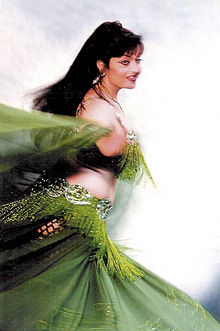
There are many fitness crazes coming out at the moment, which seems to be due to the increasing amount of awareness surrounding the importance of exercising to help combat the obesity epidemic.
I like belly dancing because:
- It's a whole lot more fun than situps
- It's easy to move when you've got a good drum beat
- Dancing is fun
- It teaches isolation of muscles as well as balance
Many people are surprised to learn that Middle-Eastern Dance, commonly known as "belly-dance," involves much more than the belly! In fact, belly-dance can benefit many parts of the body. Here are some of the health benefits of Middle-Eastern Dance:
·Exercising the carrying muscles without impact. A belly-dancer uses her quadriceps, hamstrings and glutes to hold her steady as she performs hip movements or travels smoothly across the floor. However, even though she gets a great lower-body workout, the amount of impact to her knees and ankles is minimal.
·Building the back muscles evenly. Belly-dancers use their torsos a lot-much more than ballet, modern or tap dancers. These movements, coupled with shoulder movements, exercise the back muscles, and they exercise the muscles evenly. Strong back muscles prevent back injuries, and they promote good posture as well.
·Exercising the arms. Belly-dancers have to hold their arms up for long periods of time, and it actually takes quite a lot of strength to perform arm movements slowly and gracefully.
·Aiding digestion. It's true! Exercising the abdominal area, not just by rolling the belly, but also by swaying the torso, helps food move along the digestive system. Any form of exercise will have this effect to some degree, but belly-dance is especially good for this purpose.
Belly dance is a non-impact, weight-bearing exercise and is thus suitable for all ages, and is a good exercise for the prevention of osteoporosis in older people. Many of the moves involve isolations, which improves flexibility of the torso. Belly dance moves are highly beneficial to the spine, as the full-body undulation moves both lengthen (decompress) and strengthen the entire column of both spinal and abdominal muscles in a gentle way.
ZUMBA® Fitness is the latin-inspired dance-fitness program that has spread across the world.
Zumba is a form of exercise that combines elements of Latin, swing and ballroom dance (and sometimes hip-hop dance as well). A typical class at De Baile, for example, incorporates bachatta, cha-cha, jive, samba, merengue and salsa moves, along with lots of body conditioning exercises.
The instructor builds high-intensity movements into each dance style, and then allows you to slow down a little before kicking it up again, so Zumba utilises high-intensity interval training (HIIT). Each of these dance styles has its own unique movements and qualities – for example the jive is a really energetic and fast-paced dance, the cha-cha is sassy with lots of fierce attitude, and the samba is earthy and sensuous. Each dance style also targets certain parts of your body while engaging the entire body – for example the samba provides a great core workout, while the cha-cha is great for the hips and thighs.
I would definitely recommend Zumba for anyone looking for a fun, fast-paced, energetic and effective workout. It’s really easy to follow if you have a good instructor, and it’s really enjoyable into the bargain. You just might feel a little silly shaking your hips to the Latin beat in your very first class, but trust me, before long, you’ll be hooked.
Venue: De Baile Studio, 33 Moloney Street, Lagos Times: Mondays & Fridays at 6.30pm, Saturdays at 10.30am Contact no: 08023005649
Culled from adura-odesanya.co.uk
Legally Muscled Fitness Promotions offers the following services:
1 to 1 Personal Training (including 'At Home')
Group (up to 5 people) Personal Training <-- Money Saver!
The term 'shadowboxing' comes from a training method that boxers use where they pretend to box their shadow on a wall, although more commonly they use a mirror. Shadowboxing basically has you punching the air and moving around practicing your drills and pretending to defend against an attacker.
Shadowboxing is the most cost effective boxing training method you can use to improve your boxing skills. If you think about it, shadowboxing requires absolutely no equipment, and you can do it anywhere and nearly anytime.
You can use shadowboxing a number of different ways to improve your boxing skills. It is not necessarily just random punching and moving, although it could be. Here are a few shadowboxing drills for you to incorporate into your workouts:
1. Movement Shadowboxing. This is where you develop some agility and light footwork. Your goal here is to concentrate on how you are moving around in your boxing stance. Move forwards, backwards, side to side, pivot, hop, pendulum step, etc Once you get comfortable with the movement, add in some punches, but the focus is still on the movement. Visualize how your feet are turning and moving in relation to the punches you are throwing.
2. Pivot and T Frame Shadowboxing. In this round, while you shadowbox, your focus is on maintaining the T Frame, keeping your shoulders above your knees and pivoting correctly while throwing your punches. You can move around all you want, throw whatever you want, but at all times, your focus is on the pivot and T-Frame.
3. Shadowboxing Combinations. For this drill I recommend that you start out doing a round of movement shadowboxing followed by a couple more rounds of specific combinations. For instance, one entire round, you can do shadowbox jabs alone. They can be single jabs, double jabs, triple jabs, jabs to body then to head, and so on. But, the focus is the jab. The next round, the focus may switch to the 1-2 in which case you will spend the entire round throwing technically correct jabs followed by straight rights (or lefts for the southpaws). The next round they may do 1-2-3 combinations and so on. The key is to focus on drilling a specific combination for the entire round.
4. Shadowboxing for Speed. This is quite fun and introduces a little bit of competition into the mix. Shadowboxing for speed means the boxer will throw as many punches as he can in the span of the round. They should still be throwing technically correct punches, but the real aim is to let their hands fly and count how many punches they can throw in three minutes. It's best to track this so the boxer can attempt to beat whatever he did last time. Being able to throw 250-300 punches in three minutes is a good goal to work towards. One can also introduce constraints into this, for instance, throw as many jabs as you can in three minutes, etc... to mix it up and keep yourself from getting bored.
5. Shadowboxing an Opponent. The opponent is yourself and this is where a mirror is really handy. Having the boxer box himself will show him where his weaknesses are. He can see when he leaves his head open or if his punches are off target. He can see if he is bending his knees fully when going down for a body punch or if his slips are crisp, clean, and fast. It may seem vain to an outsider, but boxing in a mirror will show you what your opponent sees and therefore what you need to fix before getting in the ring.
6. Shadowboxing Free For Alls. Anything goes. Picture an opponent and move, punch, and defend against what he is doing to you. Takes an imagination, but if you can picture yourself hitting someone and then reacting to whatever they do, you'll engrave it in your head that much quicker. This is where the real implantation happens from learning a skill to putting it in your arsenal. When you can visualize a scenario in vivid detail and respond with zero hesitation, you'll have that skill with you in the ring. It's kind of like learning a second language. Experts say that once you begin dreaming in that language, you're well on your way to becoming fluent in it.
7. Slow Motion Shadowboxing. Do everything deliberately in slow motion concentrating on perfect technique. This will show you the mechanics behind a certain combination or punch and allow you to correct the little things - foot off center, not enough pivot, weight distributed slightly wrong, etc.
8. Shadowboxing with Weights. Start small, holding small dumbells or weights in either hand as you shadowbox. The added weight will not only aid in simulating a ring situation as you put on 10-16oz gloves, but the increased weight will help strengthen and develop your shoulders and possibly help your speed when you aren't holding the weights.
There are so many ways to enrich your exercise repertoire; don't get stuck in a rut doing stuff that bores you, switch up your workouts from time to time in order to challenge your body and shock it into weight loss.
To schedule a training session with me, send an email to legallymuscledfitness@yahoo.com stating your name, age, sex, location and telephone number.
To show my love and appreciation for my readers, I have decided to give away some ebooks worth $100, and they're free of charge!
These ebooks are designed to help you live a high quality life, filled with the best things this world has to offer, and more.
Just Click on the links below to download your free ebooks.
How to be a More Confident and Productive Writer
by Freewritingadvice.Com
Do you need some practical tips to help with your writing? Would you like to be able to write more or to feel better about what you do write? This ebook will give you great practical tips on how to increase your productivity as well as how to better understand yourself as a writer and your own capacity to write. Understanding your own writing capacity will help boost your confidence and spur you on to write even more.
Let’s Get Digital: How To Self-Publish, And Why You Should.
This guide contains over 60,000 words of essays, articles, and how-to guides, as well as contributions from 33 bestselling indie authors including J Carson Black, Bob Mayer, Victorine Lieske, Mark Edwards, and many more.
It covers everything from how the disruptive power of the internet has changed the publishing business forever to the opportunities this has created for writers. It gives you practical advice on editing, cover design, formatting, and pricing. And it reveals marketing tips from blogging and social networking right through to competitions, discounts, reviews, and giveaways.
If you are considering self-publishing, if you need to breathe life into your flagging sales, or if you want to understand why it’s a great time to be a writer, Let’s Get Digital: How To Self-Publish, And Why You Should will explain it all.
Understanding Karate-do: A Guide to Unity of Body, Mind, and Soul
by Owen Johnston
Karate is an exciting and rewarding holistic pursuit practiced by millions around the world. Whether you are an existing or prospective student of martial arts, there is always something new to learn. I have hopefully provided a good starting point, as this guide details karate history, various techniques, combat principles, and philosophy.Understanding Karate-Do as a way of Life
Gifts For You
Dangerous Journey by Brian H. Jones
Living with cancer, surviving cancer: a personal memoir of hope, experience, and fortitude.Dangerous Journey
Living The Fit Life by Patrick McCrann
One of the most important elements of being an endurance athlete is the lifestyle that accompanies your activity. Your decision to do a triathlon or a marathon means that you have had to organize almost everything you do in such a way that you can actively participate to your fullest. Yet so many people make critical mistakes, setting themselves up for failure. Patrick has created five ‘fit life’ commandments that will allow you to make sure your triathlon and marathon goals map to the real world…and that you succeed at both! Living A Fit Life
Skipping, when you think about it, is a part of our culture. It’s a natural part of being a human. As children, we skip in play; we skip in dance; we skip just for the heck of it. Why did we quit skipping? Maybe for the same reasons adults quit giggling to themselves, splashing in puddles, or staying in awe of life’s simple pleasures. We have much to learn from children, and a good way to start is by skipping–you’ll be amazed at the kid-like thoughts and feelings that can arise as you skip along your merry way. (www.iskip.com/blog/benefits/)
Not only does skipping have all the benefits of a good workout – it makes you happy too! What better exercise than one that actually, physically, physiologically makes you happy. Think about it…you see joggers with grimaces on their faces; even walkers seem to be unpleasantly completing a task. But if you ever watch someone while they’re skipping, they’ll be smiling.
Remember, skipping is a strenuous exercise SO START SLOWLY!!!!
Find the Right Skipping rope for your Height
To ensure that the rope is the right size for you, stand on the middle of the rope and pull the handles upwards until the rope is taut. The handles should be in the middle of the chest, just beneath the shoulders. You can shorten most skipping ropes by tying the string shorter.
You will need a springy surface to perform this workout, so avoid concrete and tiles. Choose carpeted or wooden floors or, better still, head outdoors to a grassy garden or park.
If you haven't skipped for a long time, start by practising your timing – hold both handles of the rope in one hand and rotate it in a circular movement to your side; when the rope hits the floor, jump.
Keep your jumps small to keep impact on your knees and ankles to a minimum – you only need to raise your feet about an inch off the ground. Progress to jumping over the rope once you are confident your timing is correct.
Keep aware of your posture, keeping abs pulled in and your pelvis neutral, to make sure the workout is safe.
Before you start, look straight ahead; waist and back kept straight; then lower your elbows, keeping both at an angle of about 90 degrees. Swing the rope using wrists, not arm action. Keep your feet close together and your knees slightly bent, to absorb the shock of landing.
Warm up and cool down by marching on the spot for 3-5 min, and stretching your calves. Try skipping for 20-30 seconds, marching on the spot for 30 seconds, repeat.
As your fitness improves you can increase the time you skip for. Once you have perfected the basic move, you can make your workout more interesting by trying some of the following jumpsAim for about 70 skips a minute (each time you change foot counts as one skip). Pick up speed to 80 as the workout progresses. For fast skips, aim for 90.
·Skip Jump - hop on one foot and kick the other foot to the front (or behind) the body, alternate legs.
·Jog Jump - alternate your feet in a jogging movement as you jump the rope.
·Hop Jump – hop on one leg for several jumps, alternate legs (start with 2 per leg and increase as you improve) ·Jack Jump – do "jumping jacks" as you jump – one jump land with your legs apart, next jump land with them together
·Skipping on the spot -Keeping your back and head straight, gently jump from one foot to the other, allowing the rope to pass under your feet, and shifting your weight from one foot to the other as you skip.
·The twister - As you jump, twist to the sides, alternating left and right. This will help with your torso toning.
·
·Knee lift - As you skip, alternatively lift one knee high; but beware that this will hurt if you do it too fast!
·Cross over - Try crossing your arms/wrists in front of you, so you make a loop in the rope and jump through it. Alternate with normal swings - much harder than it looks!
·Skipping backwards - Rotate arms in a backwards motion. Step backwards instead of forwards

 Posts
Posts