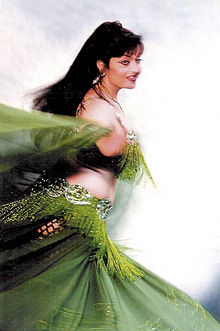
There are many fitness crazes coming out at the moment, which seems to be due to the increasing amount of awareness surrounding the importance of exercising to help combat the obesity epidemic.
I like belly dancing because:
- It's a whole lot more fun than situps
- It's easy to move when you've got a good drum beat
- Dancing is fun
- It teaches isolation of muscles as well as balance
Many people are surprised to learn that Middle-Eastern Dance, commonly known as "belly-dance," involves much more than the belly! In fact, belly-dance can benefit many parts of the body. Here are some of the health benefits of Middle-Eastern Dance:
· Exercising the carrying muscles without impact. A belly-dancer uses her quadriceps, hamstrings and glutes to hold her steady as she performs hip movements or travels smoothly across the floor. However, even though she gets a great lower-body workout, the amount of impact to her knees and ankles is minimal.
· Building the back muscles evenly. Belly-dancers use their torsos a lot-much more than ballet, modern or tap dancers. These movements, coupled with shoulder movements, exercise the back muscles, and they exercise the muscles evenly. Strong back muscles prevent back injuries, and they promote good posture as well.
· Exercising the arms. Belly-dancers have to hold their arms up for long periods of time, and it actually takes quite a lot of strength to perform arm movements slowly and gracefully.
· Aiding digestion. It's true! Exercising the abdominal area, not just by rolling the belly, but also by swaying the torso, helps food move along the digestive system. Any form of exercise will have this effect to some degree, but belly-dance is especially good for this purpose.
Belly dance is a non-impact, weight-bearing exercise and is thus suitable for all ages, and is a good exercise for the prevention of osteoporosis in older people. Many of the moves involve isolations, which improves flexibility of the torso. Belly dance moves are highly beneficial to the spine, as the full-body undulation moves both lengthen (decompress) and strengthen the entire column of both spinal and abdominal muscles in a gentle way.

 Posts
Posts