Total Pageviews

Showing posts with label belly dancing. Show all posts

Monday, 19 May 2014

BUST STOMACH FAT WITH THE PLANK!!!

Culled from fitness bloggers
 
For a long time this has been one of my favorite exercises. It’s one of those that you see someone doing in the gym and you think to yourself, “Yeah that looks pretty easy!” Of course in reality its a lot harder than it looks, but what does it do? Put simply it’s a core exercise designed to improve strength and tone in the stomach and lower back. It’s particularly favored by both serious athletes and newbies alike. Even post-natal moms are often advised to do the plank as static stomach exercises place less aggressive stress on your stomach muscles following child-birth.
 
Performing the Plank

First bend your elbows at 90 degress, forearms on the floor, elbows beneath your shoulders. Your body should be straight like a plank of wood from your head to your feet. This is important. Many newbies will lift their bum up in the air so they look more like a hump-back bridge! This is not a plank. For those who are struggling with the plank then a modified plank with your knees on the floor will make it a lot easier.
 
plank-exercise
Whats a Good Time For The Plank?

I’ve always been able to hold the plank for a reasonable while. I remember in my early 30′s being able to hold for 3 minutes. Nowadays I can do about 2 minutes. The plank is an exercise that with practise you can greatly improve your own time. In fact the best way to develop your strength is to do the plank in steps, 30 seconds and then a pause for 10 (or however long you need) and so on.
 
Plank Variations

The great think about the plank is that there are plenty of variations and tweaks you can make to vary things up a little, from one foot off the floor to even one arm off the floor (what I call hitch-hiker planks).
one-leg-plank
 
The World Record for the Abdominal Plank is 1 hour and 5 minutes…ouch! I wince just thinking about that!
 
If you’ve tried it, how long can you hold the plank for?

Friday, 17 May 2013

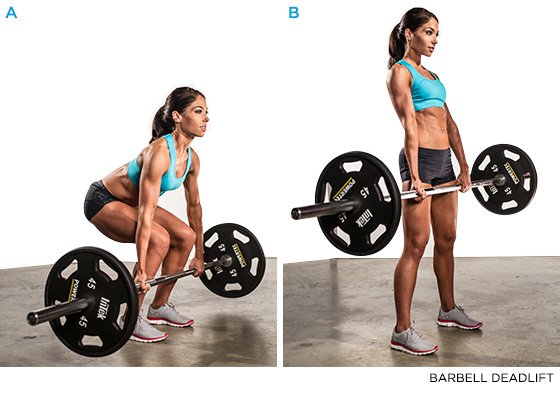
DEADLIFT YOUR WAY TO A FIT BODY!!!


 It has been a long time since I last posted on LegallyMuscled. I hope you are getting closer to you goal of maintaining a fit mind and a strong body - a body that is living and pulsating with the vigorous energy of aliveness through lifting weights.

Many people have a love-hate relationship with the deadlift. I rather dread the deadlift myself because of the soreness I normally feel when I use them in my training.
 
Deadlifts is one of the few exercises that truly stimulate both the lower and upper body. The same cannot be said of squats, which focus mainly on the lower body. Deadlifts work your backside, giving it a firm and rounded look.  upper thighs, hamstrings, lower back, upper middle back, traps, and gives a kind of "fullness" in the chest (take note guys). 

Do not round or flatten your back at any time! This is very important. If you round or flatten your back on the initial pull or to get that last rep you're risking a serious injury that might set you back months or totally end your weightlifting career. If you cannot do deadlifts with good form then do not do them, period. 

 Do not deadlift when you have a pinch in the lower back, it may be a warning sign of injury.


Oops, you forgot your mojo? Deadlift.

Wednesday, 14 December 2011

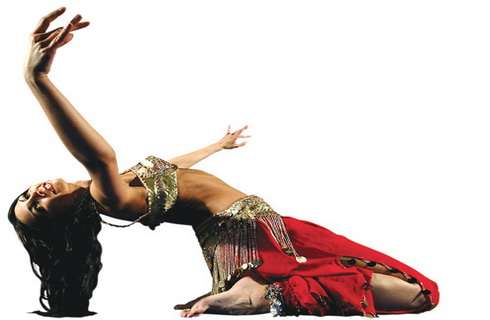
Belly Dancing Techniques


Rib Slide
Targets: Rectus Abdominus and Obliques

·         Stand with hands on hips and feet together.
·         Move just your ribs to the left, then back through the center of your torso and to the right.
·         Continue moving from side to side.

Hip Circle
Targets: Obliques and Glutes

·         Standing with feet hip-width apart and arms slightly lifted at sides; shift your hips to the right, as if you were hula-hooping.
·         Then move them in a circular motion to the front, left, and back.
·         Repeat in the opposite direction.
·         Continue alternating.

Horizontal Figure Eight
Targets: Lower Portion of Rectus Abdominus

·         Stand with arms out to sides and feet hip-width apart.
·         Lean right hip diagonally forward.
·         Shift it to the right side, then around to the back and center.
·         Repeat with the left hip and continue alternating, as if your hips were drawing a figure eight on the floor.

Vertical Figure Eight
Targets: Lower Portion of Rectus Abdominus and Obliques

·         Lift right hip and heel and lean to the right.
·         Drop hip and heel, returning hips to center.
·         Repeat to left side.
·         Now combine both sides into a smooth motion.
·         Imagine you're drawing a figure eight on the wall in front of you with your belly button.

Camel
Targets: Rectus Abdominus

·      Press chest forward while drawing shoulders and arms at your sides and arching your spine.

·   Reverse this motion by pulling abs in, tucking pelvis, and bringing shoulders forward.

·       Continue alternating to create a rippling S with spine.

Belly Roll
Targets: Rectus Abdominus

·         Lift right hip and heel and lean to the right.
·         Inhale and expand your rib cage, then pull in the lower portion of your abdominals.
·         Reverse the motion by relaxing and expanding your lower belly as you draw in your upper belly.
·         Alternate between the two movements, creating an undulating wave with your abdominals.

Belly dancing is a great fun way to shake off that belly fat. If you are looking for a new way to lose belly fat, and are feeling adventurous, then start belly dancing without delay.

Monday, 12 December 2011

Belly Dancing Contd


There are many fitness crazes coming out at the moment, which seems to be due to the increasing amount of awareness surrounding the importance of exercising to help combat the obesity epidemic.

I like belly dancing because:

- It's a whole lot more fun than situps
- It's easy to move when you've got a good drum beat
- Dancing is fun
- It teaches isolation of muscles as well as balance

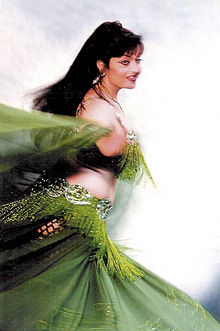
Many people are surprised to learn that Middle-Eastern Dance, commonly known as "belly-dance," involves much more than the belly! In fact, belly-dance can benefit many parts of the body. Here are some of the health benefits of Middle-Eastern Dance:

·         Exercising the carrying muscles without impact. A belly-dancer uses her quadriceps, hamstrings and glutes to hold her steady as she performs hip movements or travels smoothly across the floor. However, even though she gets a great lower-body workout, the amount of impact to her knees and ankles is minimal.

·         Building the back muscles evenly. Belly-dancers use their torsos a lot-much more than ballet, modern or tap dancers. These movements, coupled with shoulder movements, exercise the back muscles, and they exercise the muscles evenly. Strong back muscles prevent back injuries, and they promote good posture as well.

·         Exercising the arms. Belly-dancers have to hold their arms up for long periods of time, and it actually takes quite a lot of strength to perform arm movements slowly and gracefully.

·         Aiding digestion. It's true! Exercising the abdominal area, not just by rolling the belly, but also by swaying the torso, helps food move along the digestive system. Any form of exercise will have this effect to some degree, but belly-dance is especially good for this purpose. 

Belly dance is a non-impact, weight-bearing exercise and is thus suitable for all ages, and is a good exercise for the prevention of osteoporosis in older people. Many of the moves involve isolations, which improves flexibility of the torso. Belly dance moves are highly beneficial to the spine, as the full-body undulation moves both lengthen (decompress) and strengthen the entire column of both spinal and abdominal muscles in a gentle way.